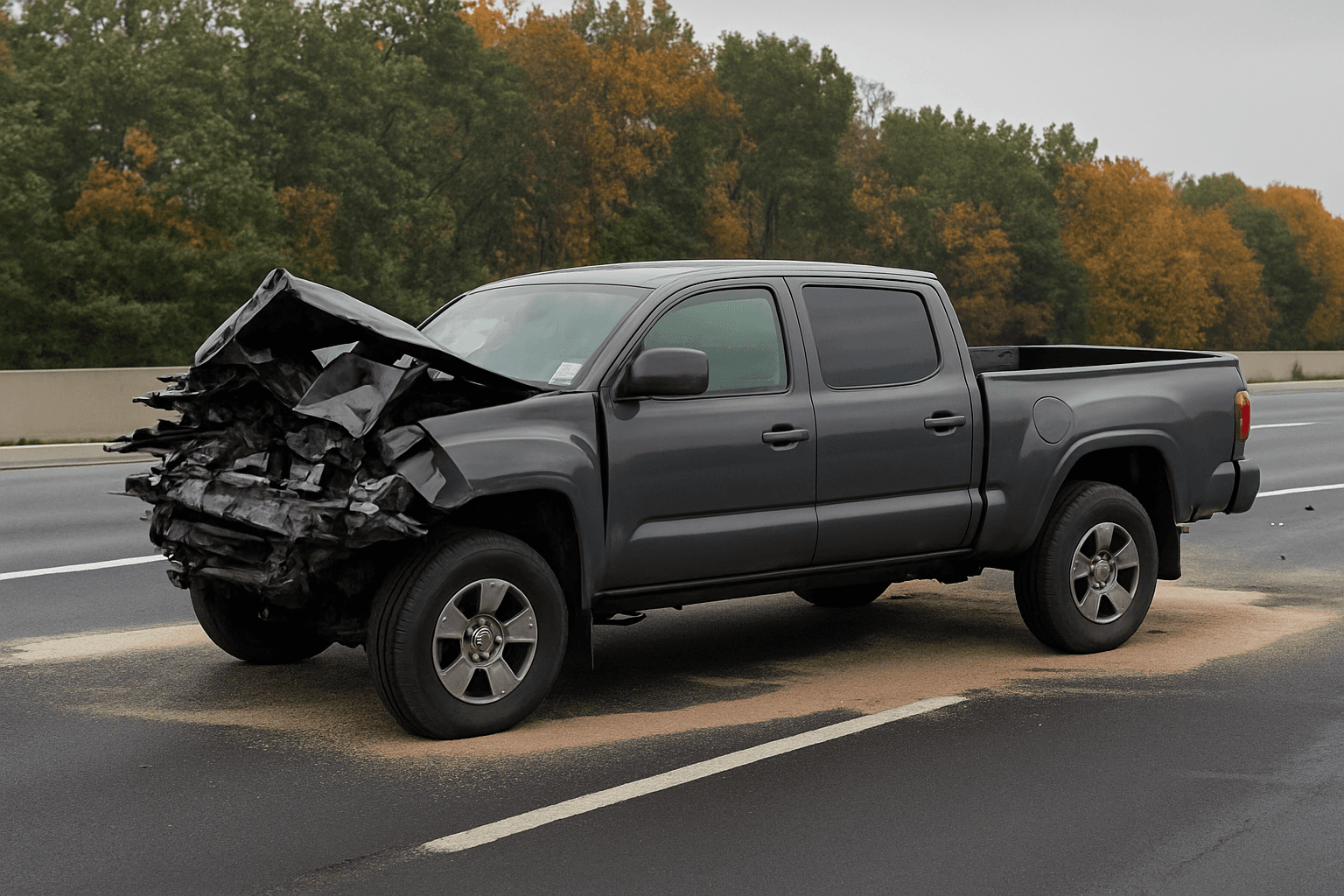
One at-fault accident after decades of clean driving puts you in a rate category you've never faced. Most New York carriers impose surcharges for 3 years, but the spread between highest and lowest quotes widens dramatically for senior drivers — and discount eligibility changes.
How New York Carriers Price One At-Fault Accident for Drivers Over 65
A single at-fault accident in New York triggers a surcharge that appears on your premium for 3 years from the accident date. For a driver over 65, the base surcharge typically ranges from 20% to 40% depending on claim severity and your carrier's rating tier, but the actual premium impact compounds differently than it does for younger drivers because of how mature driver discounts interact with accident surcharges.
Most New York carriers apply the accident surcharge before calculating age-based or course-completion discounts, which means your 5% to 10% mature driver discount reduces a higher base premium. A small subset of carriers calculate discounts first, then apply surcharges — the order of operations creates a $15 to $30 monthly difference on identical coverage. Geico and Progressive use surcharge-first calculation in New York; Erie and Travelers use discount-first in most rating classes.
The 3-year clock starts the day of the accident, not your renewal date or claim closure date. If your accident occurred January 15, 2023, the surcharge drops from your premium on the renewal that includes or follows January 15, 2026. Carriers cannot extend the surcharge window beyond 3 years under New York insurance law, but they are not required to notify you when the surcharge period ends — you must request re-rating or shop at the 3-year mark to capture the reduction.
What One At-Fault Accident Actually Costs in Monthly Premium for Senior Drivers
Before the accident, a 68-year-old New York driver with full coverage on a 2019 Honda CR-V and a clean 40-year record typically pays $95 to $140 per month depending on county and carrier. After one at-fault accident with $8,000 in property damage, that same driver's premium moves to $130 to $210 per month for the 3-year surcharge period.
The percentage increase is consistent across age groups, but the dollar impact is higher for senior drivers because their pre-accident base rates are already elevated due to age-curve pricing that begins around age 70 in most carrier models. A 45-year-old driver sees a $25 monthly increase from the same accident; a 72-year-old sees a $40 to $50 increase on identical coverage and claim severity.
Geico, State Farm, and Allstate apply the lowest accident surcharges for senior drivers in New York — typically 20% to 28% for a first at-fault incident under $10,000. Liberty Mutual and Nationwide apply mid-range surcharges of 30% to 35%. Progressive and Travelers apply the steepest surcharges for this profile, often 38% to 42%, which makes them poor renewal choices immediately post-accident despite competitive clean-record pricing.
Compare rates from carriers that specialize in senior drivers
Mature driver discounts, low-mileage rates, and coverage reviews — see what you're actually eligible for.
Get Your Free Quote✓ Mature Driver Discounts✓ No Obligation✓ Licensed Carriers✓ All 50 States
Which Mature Driver Discounts Survive an At-Fault Accident in New York
New York does not mandate mature driver discounts, but most carriers writing in the state offer a 5% to 10% discount for drivers 55 or older who complete an approved defensive driving course. The course must be New York DMV-approved, typically runs 6 hours, and renews every 3 years. The discount question after an at-fault accident is whether your carrier requires you to re-complete the course to maintain eligibility or whether the existing discount continues through your surcharge period.
State Farm, Geico, and Erie allow the mature driver discount to continue through an accident surcharge period as long as the original 3-year course certification window has not expired. If you completed your course in 2022 and had an accident in 2023, your discount remains active until 2025 regardless of the accident. Progressive and Travelers require course re-completion within 6 months of any at-fault claim to maintain discount eligibility, even if your original certification is still active — this effectively removes the discount for most of the surcharge period unless you re-enroll immediately.
AAA Northeast offers the most favorable structure for New York senior drivers post-accident: their mature driver discount applies separately from accident surcharges and does not require re-certification after a claim. The discount is smaller — 5% versus 8% to 10% at other carriers — but it remains in place without additional action, which saves $8 to $12 monthly during the surcharge window when most competitors remove it.
How Low-Mileage and Telematics Programs Change After an At-Fault Claim
If you were enrolled in a low-mileage or telematics discount program before your accident, most New York carriers suspend or recalibrate your participation after an at-fault claim. Geico's DriveEasy and Progressive's Snapshot programs pause new data collection for 60 to 90 days post-claim and re-baseline your discount tier starting from zero — even if you previously qualified for the maximum 10% to 15% safe-driving discount.
State Farm's Drive Safe & Save program does not pause after an accident, but it recalculates your risk score to reflect the claim, which typically drops your discount tier by 40% to 60% for the first year post-accident. A senior driver who earned a 12% telematics discount before a claim will see that drop to 5% to 7% immediately after the claim closes, then gradually recover if no new incidents occur. The discount floor remains in place — you will not lose telematics savings entirely — but the reduction compounds with the accident surcharge.
Low-mileage discounts based solely on annual odometer verification, such as Allstate's Milewise and Nationwide's SmartMiles, typically continue post-accident as long as your mileage remains under the threshold. These programs treat mileage and driving record as independent rating variables, which makes them more stable for senior drivers who drive under 7,500 miles annually and experience a single at-fault incident.
When to Drop Collision Coverage After an At-Fault Accident on an Older Vehicle
Most senior drivers asking this question own a vehicle that is paid off and 6 to 12 years old. The decision framework is cash value of the vehicle, cost of collision coverage, and whether you could replace the vehicle out-of-pocket if totaled. After an at-fault accident, collision premiums increase proportionally with your liability surcharge — collision is typically 30% to 40% of your total premium, so a 30% overall surcharge raises your collision cost by roughly the same percentage.
If your 2015 Honda Accord is worth $7,500 and your collision coverage costs $45 per month before the accident, it will cost $55 to $62 per month during the surcharge period. Over 3 years, you will pay $1,980 to $2,232 to insure a vehicle worth $7,500, and your deductible is likely $500 to $1,000, which means the maximum net payout from a total loss is $6,500 to $7,000. If you have $7,000 in accessible savings and could replace the vehicle without financing, dropping collision after an at-fault accident is financially sound.
If you drop collision, you must keep comprehensive coverage if you live in a county with meaningful theft, weather, or animal-strike risk. Comprehensive premiums do not increase after an at-fault collision claim because comprehensive covers non-collision perils. In New York, Erie and Allstate offer the lowest standalone comprehensive rates for senior drivers, typically $18 to $28 per month with a $250 deductible on a vehicle valued under $10,000.
Which New York Carriers Offer Accident Forgiveness for First-Time At-Fault Claims
Accident forgiveness prevents a surcharge from applying after your first at-fault claim, but eligibility requirements are strict and most carriers exclude drivers over 70 from enrollment. Geico offers accident forgiveness as an optional endorsement in New York for drivers 65 to 69 with 5 years of prior continuous coverage and no at-fault claims in the preceding 5 years. The endorsement costs $4 to $7 per month and applies to one at-fault accident up to $15,000 in damages.
Liberty Mutual includes one-accident forgiveness automatically for drivers with 5 years claim-free tenure, but the program caps at age 70 — drivers 71 and older are excluded regardless of tenure or clean record length. State Farm offers accident forgiveness in New York only to drivers enrolled in their Drive Safe & Save telematics program who maintain a top-tier risk score for 12 consecutive months, and the benefit applies to accidents under $5,000 in damages only.
If you are over 70, your only path to accident forgiveness is Erie's Silver Level policy tier, which includes one minor accident forgiveness automatically after 3 years of claim-free coverage with Erie and does not impose an age cap. The tier requires bundling home and auto, and base premiums are 8% to 12% higher than Erie's standard policies, but the structure is the only post-70 accident forgiveness option writing in New York.
How to Compare Quotes Post-Accident Without Triggering Additional Rate Increases
Shopping for coverage after an at-fault accident does not increase your premium or add points to your record — your accident history is already reported to the New York DMV and appears in the CLUE database that all carriers access during underwriting. What changes between carriers is how heavily they weight the accident relative to your age, tenure, and total claim history.
When requesting quotes, provide the exact accident date, claim amount, and fault determination. If your accident was March 10, 2024, with $6,200 in damages and you were found 100% at fault, state that clearly. Approximations or omissions will be corrected during underwriting, and any rate quoted before correction is non-binding. Carriers cannot legally provide a firm quote without pulling your CLUE report and MVR, both of which surface the accident independently of what you disclose.
Quote at least five carriers. The rate spread for a senior driver with one at-fault accident is wider than the spread for a clean-record senior by a factor of two — where clean-record quotes might range from $110 to $160 monthly, post-accident quotes will range from $135 to $260 for identical coverage. Geico, State Farm, and Erie consistently quote the lower end of that range for New York senior drivers; Progressive and Travelers quote the higher end unless you bundle home insurance.